The code of a fair fight
West Side StoryThe code of a fair fight is a street-level rule for making violence seem bounded, honorable, and answerable to shared terms. In the Jets’ dispute with the Sharks, it becomes a negotiation over weapons and the meaning of courage: a fight with fists can be presented as clean, while knives and guns threaten to turn the contest into something harder to control. The code matters not because it resolves the conflict, but because it exposes how the gang members try to distinguish their own violence from the violence they condemn.
Definition and Social Setting
The code takes shape in a neighborhood where gangs are visible, residents often avoid confronting them, and public institutions struggle to draw young people into shared spaces. On Manhattan's West Side, people watching the Jets pass either openly approve or avert their eyes; in the crowded streets, trouble seems abundant, while ordinary residents have little room to escape the conditions around them. Some people regard the Jets as helping preserve what remains of the neighborhood, even when they dislike the boys’ methods, because politicians do not appear to act on residents’ behalf. That mixture of abandonment and tolerance gives the gang’s own rules practical force: the Jets claim a role in public life while enforcing it through intimidation.
The Municipal Community Center offers a contrasting, organized attempt to bring neighborhood young people together. It was established in a former church and intended to provide supervised recreation and instruction, but its open-door policy became a source of division: longtime residents avoided it when they learned that Puerto Ricans were welcome, and Puerto Rican families stayed away because the center was being boycotted by the other group. At a dance, Jets and Sharks attend without fighting, yet remain on opposite sides of the floor, dancing as if a wall separated them. The center’s failed effort at integration does not itself define the fair-fight code, but it clarifies the setting in which informal gang rules, rather than a common institution, organize contact between the groups.
Riff Lorton’s Terms for the Conflict
Riff Lorton first proposes ending the repeated, isolated attacks through one major battle. He is tired of the Sharks striking and running and wants the territorial conflict settled in a single confrontation. The scale of that proposal immediately raises the question of weapons. Riff warns that the Sharks may bring bottles, knives, or guns, then asks whether the Jets are prepared to meet them on whatever terms they choose. His initial position is not a categorical refusal of armed violence: he says he is ready to finish the conflict by whatever means the other side chooses.
Baby-John presses for a narrower idea of fairness. He argues for fists or stones, but not knives or firearms, and wants the Jets to challenge the Sharks to fight cleanly. In his account, accepting a clean fight would test the opposing gang’s courage; resorting to weapons would expose the Sharks as unwilling to meet the Jets directly. His appeal is partly a public standard of conduct and partly a way of confronting his own fear. He touches the dried blood at his ear, but the gesture does not give him confidence. The gap between the ideal of courage and the visible possibility of injury is present even before the terms are settled.
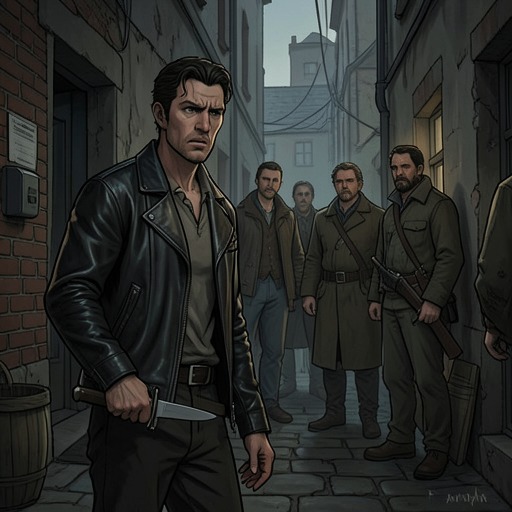
Riff accepts the proposal of a gang-to-gang encounter, but does not simply adopt Baby-John’s limit. He says the Jets will fight for their territory as they always have and that, if the Sharks bring knives, he is ready to use his own. He even presents himself as willing to mark the Jets’ name on an opponent’s body. His speech turns the code into a conditional rule: the Jets may prefer a fistfight, but they will answer blades with blades if that is what the other side brings. The threat makes the boundary of fairness unstable, since the code can restrain violence in one circumstance and authorize escalation in another.
Riff then proposes that each gang send a war council to decide the weapons together. He frames the consultation with a sarcastic appeal to white fair play, making the decision sound like principled restraint even as the discussion remains focused on how a mass fight can be conducted. As leader, he reserves for himself the privilege of personally challenging Bernardo. The procedure gives both sides a role in setting terms, but it is still a negotiation between rival gangs over a planned act of violence, not a withdrawal from the territorial contest.
Tony Wyzek Recasts Fairness
When Tony Wyzek later confronts the Jets, he attacks the logic of weapons more directly. He calls the others cowards for needing stones, knives, or guns and points to his bare knuckles as the means by which a person can meet an opponent bodily. His argument makes physical exposure the test: a fair fight requires each side to risk direct contact rather than rely on objects that increase the distance or force of an attack.
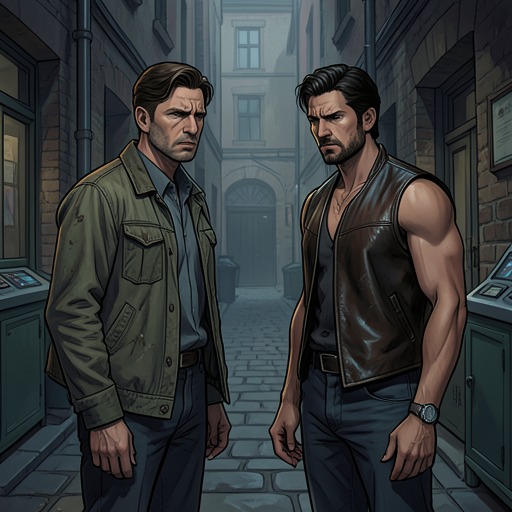
Tony also tries to redirect the dispute from a battle involving everyone toward a contest between representatives. He says a fair fight might settle matters if both sides have someone willing to fight with fists. Bernardo expresses interest and appears to hope that Tony will represent the Jets, but Riff interrupts to insist that the gang leaders decide. Riff and Bernardo agree to a fair fight on those terms; Bernardo offers his word and suggests meeting beneath the overpass that same night. Riff rejects that timing, names Diesel as the Jets’ best fighter, and says the following night will suit them. The agreement establishes a proposed contest and its immediate terms; it does not establish that the fight takes place or that the larger conflict is settled.
Limits, Relationships, and Significance
For Tony, the discussion is tied to a change in allegiance and purpose. He has left the Jets because he no longer wants to fight the Sharks, and he seeks Bernardo’s recognition of his right to see Maria. His appeal to direct combat is therefore both an attempt to change the gang’s plan and a way to show that he has changed. Later, when Maria asks whether he will go to the fight, Tony says he had not decided until she asked and then tells her he will not go. When she asks him to stop the fight for them, he agrees. The code that had offered a way to stage violence on controlled terms is now challenged by a personal obligation to prevent it.
The fair-fight ideal remains narrower than peace. Its rules concern how opponents should meet, who should fight, and which weapons count as acceptable; they do not question the gangs’ claim to territory or the premise that force can settle their rivalry. Even the preference for bodily combat can become another proof of masculine courage, while Riff’s readiness to use a knife preserves the possibility of lethal escalation. The code is thus both a restraint and a license: it offers a language for limiting violence, but also helps the Jets present their own violence as principled. Tony’s refusal to attend, followed by his promise to Maria, reveals the possibility of rejecting the contest itself rather than merely revising its rules.